
Beginning of Us
- SmartReals

- Mar 21
- 3 min read
From Matter to Mind
For most of Earth’s history, our planet held no life at all.
More than 4.5 billion years ago, the early Earth was a volatile environment shaped by volcanic activity, meteorite impacts, and an atmosphere rich in reactive gases such as methane, ammonia and carbon dioxide. As the planet cooled, oceans formed, creating vast chemical laboratories where energy from lightning, ultraviolet radiation, and geothermal heat drove complex reactions.
Within these primordial oceans, simple molecules began interacting in increasingly organised ways. Carbon compounds, water and minerals circulated through dynamic environments where chemical systems could combine, break apart and recombine endlessly.
At some point in this process, chemistry crossed a remarkable threshold.
Non-living molecules began organising into systems capable of replication and evolution.
This transition — from chemistry to biology — remains one of the most profound open questions in modern science.
Several scientific hypotheses attempt to explain how this may have occurred.
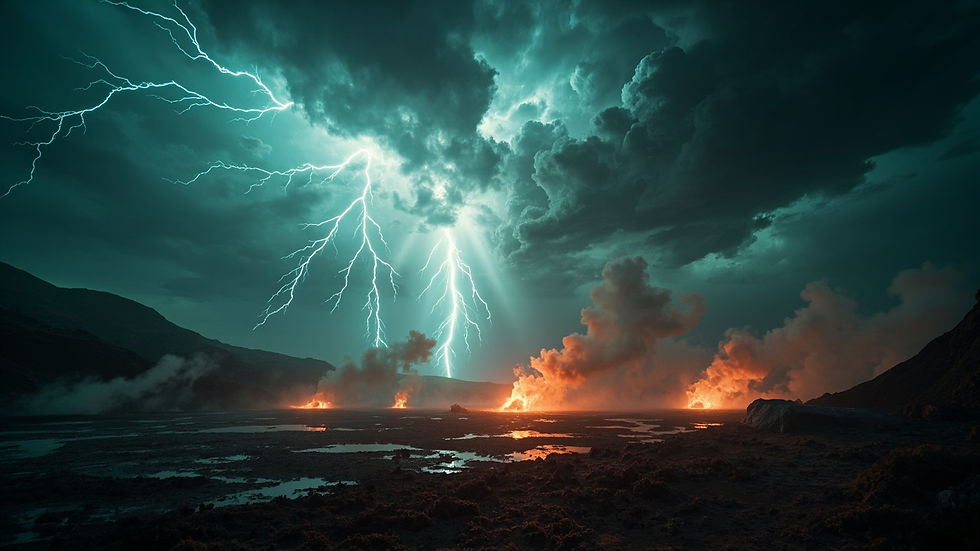
One influential model proposes that life began in alkaline hydrothermal vents, where mineral-rich fluids emerging from the ocean floor create natural chemical gradients that could power early metabolic reactions. These environments provide continuous energy sources and microscopic mineral structures that may have acted as natural reactors for early biochemical systems.
Another widely studied idea is the RNA world hypothesis, suggesting that early life relied on RNA molecules capable of both storing genetic information and catalysing chemical reactions. Such molecules may have preceded the more complex DNA–protein systems found in modern biology.
Other research focuses on the formation of lipid membranes, which can spontaneously assemble into microscopic compartments. These primitive structures could have allowed chemical reactions to occur within stable boundaries — an important step toward the formation of the first cells.
Although the precise pathway remains uncertain, geological evidence indicates that by approximately 3.5 billion years ago, life had already appeared on Earth.
Ancient microbial communities known as stromatolites, preserved in rocks from Australia and South Africa, reveal that early microorganisms were already interacting with their environment and altering the chemistry of the planet.
These early organisms were simple single-celled microbes, yet their impact on Earth’s history was immense.
Through photosynthesis, certain microbes began releasing oxygen into the atmosphere. Over hundreds of millions of years, this process transformed the planet during what scientists call the Great Oxygenation Event, making complex life possible.
Evolution then unfolded across vast geological timescales.
Cells became more complex. Multicellular organisms emerged. Marine ecosystems expanded, and eventually life colonised land. Plants reshaped Earth’s atmosphere and soils, while animals evolved increasingly sophisticated nervous systems capable of processing information and responding to changing environments.

Among these countless evolutionary branches, one lineage would eventually give rise to humans.
Our species emerged within the broader evolutionary history of primates, gradually developing distinctive traits including upright walking, dexterous hands, and expanding cognitive capacity.
Yet the defining advantage of humans was not physical strength.
It was collective intelligence.
Early humans developed tools, controlled fire, and eventually created language — a system that allowed knowledge to accumulate across generations. Culture, cooperation and shared learning enabled humans to adapt rapidly to diverse environments across the planet.

From these foundations, human societies expanded. Agriculture stabilised food supplies roughly 12,000 years ago, enabling the rise of settlements, cities and complex civilisations. Writing systems preserved knowledge across centuries, and scientific inquiry began uncovering the fundamental patterns governing the natural world.
Seen from a long-term perspective, the story of life on Earth reveals a striking progression:
Matter organised into chemistry.
Chemistry organised into biology.
Biology evolved into intelligence capable of questioning its own origins.
The same curiosity that once drove early humans to shape tools and master fire now drives modern science to explore the deepest questions about existence — from the origins of life on Earth to the possibility of life elsewhere in the universe.
And perhaps the most remarkable aspect of this story is that the universe has, through us, developed the ability to reflect on itself.

Smart Evolution: From Origins to the Future
References
Lane, N. (2015). The Vital Question: Energy, Evolution and the Origins of Complex Life. W.W. Norton.
Knoll, A. (2015). Life on a Young Planet: The First Three Billion Years of Evolution on Earth. Princeton University Press.
Martin, W., & Russell, M. (2007). On the origin of biochemistry at alkaline hydrothermal vents. Philosophical Transactions of the Royal Society B.
Sutherland, J. (2016). The Origin of Life—Out of the Blue. Angewandte Chemie International Edition.
NASA Astrobiology Program — Research on early Earth and origin of life
Knoll, A., Javaux, E., Hewitt, D., & Cohen, P. (2006). Eukaryotic organisms in Proterozoic oceans. Philosophical Transactions of the Royal Society B.


Comments